
What Is 4-Fold Ministry?
Ministry roles in the church can feel a little confusing from the outside. Pastor, apostle, evangelist, prophet, teacher; different denominations use different terms, structure things in different ways, and emphasise different gifts. For anyone trying to understand how the church is meant to function biblically, it’s worth knowing where these roles come from and why they matter.
One of the conversations that comes up in Christian theology is the idea of 4-fold ministry. It’s not as widely known as the 5-fold ministry model, but it has a thoughtful biblical foundation and continues to shape how some churches understand leadership and spiritual gifts. The scriptural anchor for both models is Ephesians 4:11, where Paul writes that Christ Himself gave certain gifts to the church for the building up of the body.
What Is the 4-Fold Ministry?
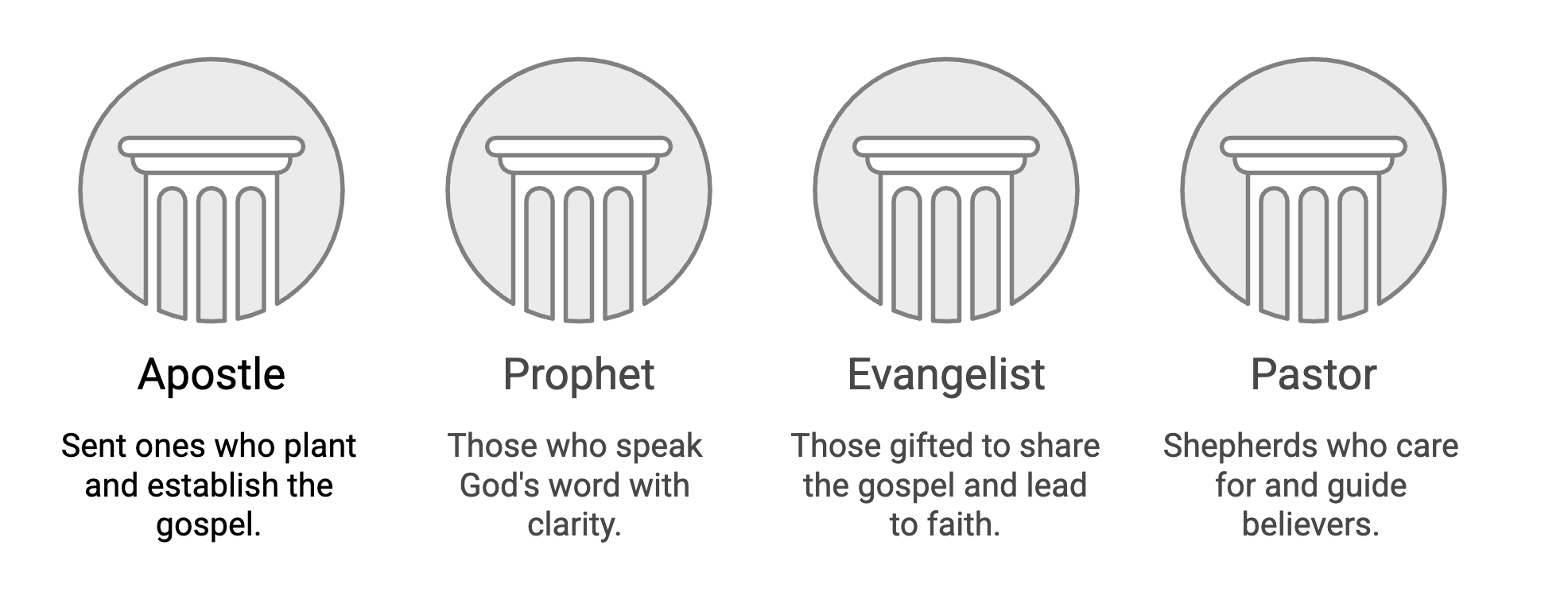
The 4-fold ministry refers to four leadership and gifting roles described in Ephesians 4:11:
- Apostle — sent ones who plant, pioneer, and establish the work of the gospel.
- Prophet — those who speak God’s word with clarity, often calling people back to truth.
- Evangelist — those gifted to share the gospel and lead people to faith in Jesus Christ.
- Pastor — shepherds who care for, guide, and nurture believers within the local church.
The defining feature of the 4-fold model is that it combines “pastor” and “teacher” into a single role, often referred to as “pastor-teacher.” This is different from the more familiar 5-fold ministry model, which treats teacher as a distinct gift. Both models draw from the same verse, but they read its grammar slightly differently, and that small difference has shaped how various streams of Christianity organise leadership.
Biblical Basis for the 4-Fold Ministry
Ephesians 4:11 reads: “So Christ himself gave the apostles, the prophets, the evangelists, the pastors and teachers, to equip his people for works of service, so that the body of Christ may be built up.”
Those who hold to the 4-fold view focus on the Greek structure of the phrase “pastors and teachers.” In the original language, both nouns share a single article, which some scholars interpret as suggesting they refer to one combined role rather than two separate ones. The reasoning is that a true pastor will naturally teach, and a true teacher within the church will naturally shepherd, making them two expressions of the same gift.
Theologians who hold this view include reformed scholars such as John Calvin, who treated pastor-teacher as essentially one office in his commentary on Ephesians. Others, including many in the Pentecostal and charismatic tradition, read the same verse differently and see five distinct roles. Neither interpretation is careless; both come from careful study of Scripture, and both seek to honour the text.
Comparison: 4-Fold vs 5-Fold Ministry
| 4-Fold Ministry | 5-Fold Ministry |
|---|---|
| Apostle | Apostle |
| Prophet | Prophet |
| Evangelist | Evangelist |
| Pastor-Teacher (combined) | Pastor |
| – | Teacher |
Arguments for the 4-fold model centre on the grammar of Ephesians 4:11 and the idea that pastoring and teaching are deeply intertwined in practice. Supporters argue that good shepherding always involves teaching, and good teaching within the church always involves a shepherd’s heart.
Arguments for the 5-fold model highlight that teaching is treated as a distinct gift in other parts of the New Testament, such as Romans 12:7 and 1 Corinthians 12:28. Many believe that teacher and pastor, while related, function differently. One focused on instruction and doctrine, the other on care and oversight.
Both models exist within the wider body of Christ, and most theologians on either side agree that the bigger goal is unity. Whether someone holds to four roles or five, the heart of Ephesians 4 is that Christ gave these gifts to equip believers, build up the church, and bring people to maturity in faith.
Practical Implications in Today’s Church
In practice, both models shape how churches structure leadership and identify spiritual gifts.
Churches that lean toward the 4-fold view often have one pastoral leader who carries both teaching and shepherding responsibilities. In smaller churches especially, this can be a natural fit. The same person preaching on Sunday is also visiting the sick and discipling new believers through the week.

Churches that lean toward the 5-fold view tend to separate teaching gifts more clearly. A teacher might lead Bible studies or training environments, while the pastor focuses on care, oversight, and the broader life of the local body.
A few common questions come up here:
- Is it biblical to remove the role of “teacher”? Supporters of the 4-fold model would say teacher hasn’t been removed, just integrated. Others argue that treating teacher as distinct better reflects the diversity of gifts described elsewhere in Scripture.
- Can one person hold multiple roles? Most theologians agree yes. Paul functioned as an apostle, teacher, and evangelist.
- Is one model more “right” than another? Both are biblically grounded, and both serve the same goal: equipping the church.
Common Questions About the 4-Fold Ministry
What is a fourfold ministry?
Fourfold ministry refers to the four leadership and gifting roles drawn from Ephesians 4:11 (apostle, prophet, evangelist, and pastor-teacher). It combines pastor and teacher into a single function based on the Greek grammar of the verse.
What are the four fold ministries of Jesus?
This phrase is sometimes used to describe the four primary expressions of Jesus’ earthly ministry: preaching the gospel, teaching truth, healing the sick, and demonstrating God’s kingdom.
What is the 4 fold purpose of the church?
The 4-fold purpose of the church is often summarised as worship, fellowship, discipleship, and mission.
What are the 4 fold interpretations of the Bible?
This refers to a classical method of biblical interpretation that reads Scripture through four lenses: literal, allegorical, moral, and anagogical.
Experience the 4-Fold Ministry in Action
At C3 Powerhouse Sunshine Coast, the 5-fold ministry model is what shapes how leadership and spiritual gifts are understood. Pastor and teacher are recognised as two distinct gifts working together, alongside apostle, prophet, and evangelist. This reflects the wider Pentecostal and charismatic conviction that all five gifts in Ephesians 4:11 are still active today, still given by Jesus Christ, and still essential for equipping believers and building up the local body.
In practice, that looks like raising up leaders across different gift areas. Teachers who unpack the word with depth, pastors who care for people, evangelists who share the gospel, prophets who speak with clarity into seasons, and apostolic leaders who pioneer and plant.
Whether someone holds to a 4-fold or 5-fold view, the heart behind it is the same: Christ gave these gifts to His church to bring believers to maturity in faith. For anyone wanting to grow in their understanding, the best next step is often a conversation with a pastor or spiritual mentor, or spending time studying Ephesians 4 in context.